Flooring is sold in fixed-size packs, not by the square metre — so the real question isn't just "what's my floor area" but "how many packs does that area actually need, once you account for wastage."
Use the calculator, or work it out by hand
Our Flooring Calculator does this automatically for laminate, LVT and engineered wood. To work it out yourself: floor area ÷ pack coverage (m² per pack) × (1 + wastage%), rounded up to a whole pack.
Pack coverage varies by flooring type
- Laminate: typically around 2.2m² per pack
- LVT / vinyl click: typically around 2.5m² per pack
- Engineered wood: typically around 1.8m² per pack
These are typical figures — always check the actual pack coverage printed on the product you're buying, since it varies between manufacturers and plank sizes.
A worked example
A living room measuring 4m × 3.5m is 14m² of floor area. Laid straight, with a 10% wastage allowance, that's 14 × 1.1 = 15.4m² needed. At roughly 2.2m² per pack for laminate, that's 7 packs (15.4 ÷ 2.2, rounded up). The same room in LVT at 2.5m² per pack needs 7 packs too, once rounded up; in engineered wood at 1.8m² per pack, it needs 9 packs.
How much wastage allowance to use
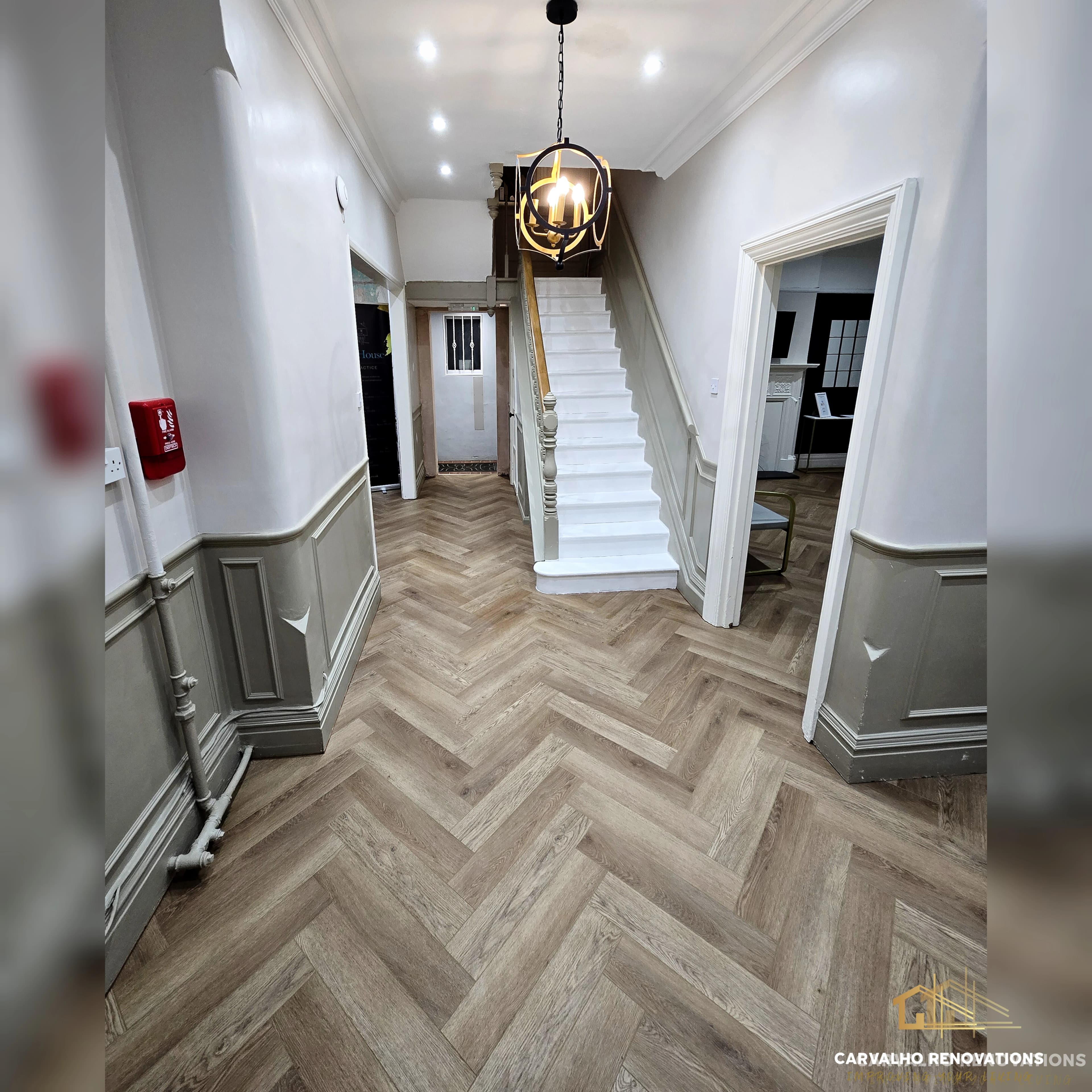
10% is a sensible default for a simple, mostly-rectangular room laid straight. Rooms with lots of alcoves, or a diagonal or herringbone laying pattern, need considerably more — 15% is a reasonable minimum for diagonal laying, and herringbone patterns commonly need 15-20% or more, since every plank is cut at an angle and offcuts are rarely reusable in the same way as a straight lay.
Underlay quantity
Underlay is bought to match the same floor area as the flooring itself, plus the same kind of small wastage allowance — it's usually sold in rolls covering a fixed area (commonly 10-15m² per roll, though this varies by product), so round up to a whole roll the same way as flooring packs.
Thresholds and transition strips
Transition strips (sometimes called threshold strips) are needed anywhere the new flooring meets a different floor covering or floor level — typically doorways between rooms, and the edge of any expansion gap against a fixed surface like a fireplace hearth. These are bought by length, not area — count doorways and transitions separately from the main floor area calculation, and measure the width of each opening.
LVT vs laminate vs engineered wood
Laminate is the most budget-friendly and widely available option. LVT (luxury vinyl tile) is more water-resistant, making it a common choice for kitchens and bathrooms. Engineered wood gives a genuine real-wood surface layer at a lower cost and better stability than solid wood, but is generally the most expensive of the three.
DIY fitting vs a professional
Click-fit laminate and LVT in a simple rectangular room laid straight is a realistic DIY job for a confident beginner with the right tools. Herringbone or diagonal patterns, engineered or solid wood requiring adhesive or nailing, and any room with an uneven subfloor needing levelling first are where professional fitting experience genuinely reduces the risk of a costly mistake.
Common mistakes that waste flooring (and money)
- Using a 10% wastage allowance on a diagonal or herringbone lay, where the real figure needed is closer to 15-20%.
- Forgetting underlay and transition strips entirely when budgeting, then having to make a second, smaller order at a worse per-unit price.
- Not checking whether packs from a second order (if the first wasn't enough) are from the same batch/shade — like paint and wallpaper, flooring can show visible batch variation.
Frequently asked questions
Related calculators
Related services
Related articles
How Much Does It Cost to Install New Flooring in the UK?
Flooring cost varies hugely by material — and installation, subfloor preparation and old-floor removal often matter as much as the flooring itself.
Subfloor Preparation: What's Needed Before New Flooring Goes Down
Good subfloor preparation is what actually determines whether new flooring lasts — here's what needs checking and fixing before anything goes down.
Why Is My Wood Flooring Creaking?
Creaking wood floors are usually caused by movement between boards and joists below — here's what's really happening and how it's fixed.
Planning a new floor?
Our flooring team can supply and fit, or just fit flooring you have already bought — get a free, no-obligation quote.
Get a Flooring Quote