Skip hire costs vary considerably by region, skip company, and how long you need it for, but here's a realistic guide to what you're likely to pay, and what actually drives the price beyond the headline size.
Typical UK skip hire prices by size
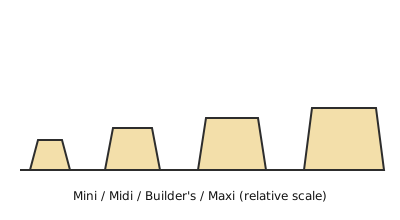
- Mini skip (2-3 cubic yards) — roughly £120-£200 for a standard hire period. Suitable for small clearances, a single room's worth of waste, or garden clearance.
- Midi skip (4 cubic yards) — roughly £150-£250. A step up for slightly larger jobs, like a small bathroom refit or a garage clear-out.
- Builder's skip (6 cubic yards) — roughly £200-£350. The most commonly hired size for a typical kitchen or bathroom renovation.
- Large builder's skip (8 cubic yards) — roughly £250-£400. Suited to larger single-room renovations or multi-room clearances.
- Roll-on-roll-off (12-40 cubic yards) — starts from several hundred pounds upward, typically for larger building projects, extensions, or full house clearances — priced individually by the skip company based on volume and waste type.
These are indicative ranges, not fixed prices — skip hire costs vary by region (London and the South East are typically higher than other parts of the UK), local landfill/waste processing costs, and how competitive skip providers are in your area. Always get a few local quotes rather than assuming a national average applies directly to you.
What affects the price beyond size
- Hire duration — most standard hires cover 1-2 weeks; longer hire periods cost more, and some providers charge a daily rate beyond the initial period.
- Waste type — general household/builder's waste is cheapest; heavier materials (rubble, soil) and certain restricted items can cost more or need a specific skip type — see our guide on what can and can't go in a skip.
- Permit requirement — if the skip needs to sit on a public road rather than your own driveway or land, you'll need a council permit, which typically adds roughly £30-£150 to the cost depending on the local authority, and the skip company usually arranges this for you as part of the booking.
- Location and access — both regional pricing differences and site access (a skip that's harder to deliver or collect, or that needs to be placed further from the collection vehicle, may cost more).
Placing a skip on your own driveway vs a public road
If a skip fits entirely on your own driveway or private land, no council permit is needed. If it needs to go on the public highway — including a road outside your house — you legally need a permit from the local council, arranged in advance of delivery. Placing a skip on a public road without one can result in a fine, so it's worth confirming this before booking rather than assuming your situation doesn't require one.
Getting the size right
Ordering a skip too small means paying for a second one, plus the disruption of a second delivery and collection; too large means paying for capacity you don't use. As a starting point, a single-room renovation (kitchen or bathroom) typically fills a 6-yard builder's skip; a full clearance of a house typically needs a large builder's skip or roll-on-roll-off depending on the property size and how much is being cleared.
For a fuller breakdown of exactly which size suits which job, see our dedicated guide: what size skip do I need?
Ways to reduce the cost
Booking further in advance rather than needing a same-day or next-day delivery sometimes gets a better rate; comparing quotes from a few local providers rather than the first result found online often reveals a meaningful price difference for the same size and duration; and being realistic about size — rather than over-ordering "just in case" — avoids paying for capacity that goes unused. Segregating genuinely recyclable material (clean rubble, metal) can also reduce costs with some providers, since it's cheaper for them to process than mixed general waste.
Skip vs alternative waste removal options
A skip isn't always the most economical choice for every job. For a small clearance, a licensed man-and-van waste removal service can work out cheaper and more convenient than a skip you'd only fill a fraction of, since you're paying for the waste actually removed rather than a fixed skip size. For a genuinely large project, a skip usually wins on cost per volume once you're filling most of a builder's skip or larger. It's worth weighing the two against the actual amount of waste you expect, not just defaulting to whichever option is more familiar.
Booking and delivery practicalities
Most providers ask for reasonable notice — a few days is often enough outside of particularly busy periods, though last-minute availability varies by area and provider. Make sure there's clear, level access for the delivery vehicle, and check whether the skip will be positioned exactly where you need it (on a driveway, for instance) rather than left wherever is most convenient for the driver, which can matter if you need continued vehicle access during the hire period.
Frequently asked questions
Frequently asked questions
Related calculators
Related articles
What Can and Can't Go in a Skip?
What's allowed and prohibited in a UK skip hire, why certain items are restricted, and how to dispose of the things that aren't allowed.
How to Choose the Right Screw or Fixing for the Job
A practical guide to choosing the right screw, wall plug, or fixing for common UK DIY jobs — matched to wall type and load, not guesswork.
How to Choose the Right Drill Bit Size
A quick, practical guide to matching drill bit size and type to the job — wall plugs, screws, masonry, wood and metal.
Planning a renovation that'll need waste clearance?
Carvalho Renovations handles waste disposal and skip logistics as part of the job, so you don't have to manage it separately.
Get a Free Quote